Story · 2026-11-28 · About 5 min read
Amazake at Kanda Myojin and an underground koji cellar
Near the great torii of Kanda Myojin, Edo’s guardian shrine, two shops make amazake from koji: one said to date from 1616, when the shrine moved to its present site, and one from 1846 that grows koji in a cellar 6 m underground. This story follows them, an eel restaurant below the shrine and a sake maker, with sources.
At the gate of Edo’s guardian shrine
According to shrine tradition, Kanda Myojin Shrine was founded in 730. After the Edo shogunate was established, the shrine was moved in 1616 to its present site, which guards the northeast of Edo Castle, a direction believed to bring misfortune. It was then revered as the guardian shrine of all Edo, by the shogunate and townspeople alike.[1]
The main hall burned in the 1923 earthquake and was rebuilt in 1934 in steel-reinforced concrete. Most buildings in the grounds were lost in the air raids of World War II, but the main hall survived with only slight damage.[1]
Near the great torii (shrine gate) are two shops that make amazake (a sweet, non-alcoholic rice drink) from koji. One is said to have opened in 1616, the year the shrine arrived. The other opened in 1846 and grows its koji in an underground earthen cellar. This story visits both, along with an eel restaurant at the foot of the shrine’s Otokozaka steps and a sake maker whose sake is offered at the shrine.[2,6,9,13]
Since 1616: Mikawaya Ayabe Shoten
Mikawaya Ayabe Shoten, a little way inside the great torii on the right, is said to have opened in 1616, the same year Kanda Myojin moved to its present site. The founder is said to have been a merchant serving the Tokugawa family who came to Edo from Mikawa Province, now Gamagori in Aichi Prefecture.[6,7]
The shop has made and sold koji since it opened, and uses it for amazake, miso and natto. Its Enju amazake has a mild, rounded taste without a strong koji flavor and is served with powdered ginger. It sells four kinds of miso, including white miso, and house-made natto, some wrapped in straw and some made with small soybeans.[6,7,8]
On the left side of the shop is a café serving amazake and sweets such as cream anmitsu and tokoroten jelly (28 seats as of January 2023). The counter also sells sake-flavored manju, rice crackers and beckoning-cat figures. It is a 5-minute walk from the Hijiribashi Exit of Ochanomizu Station or from Suehirocho Station (Tokyo Metro Ginza Line), and about 7 minutes from the Electric Town Exit of Akihabara Station.[6,8]
The underground cellar: Amanoya
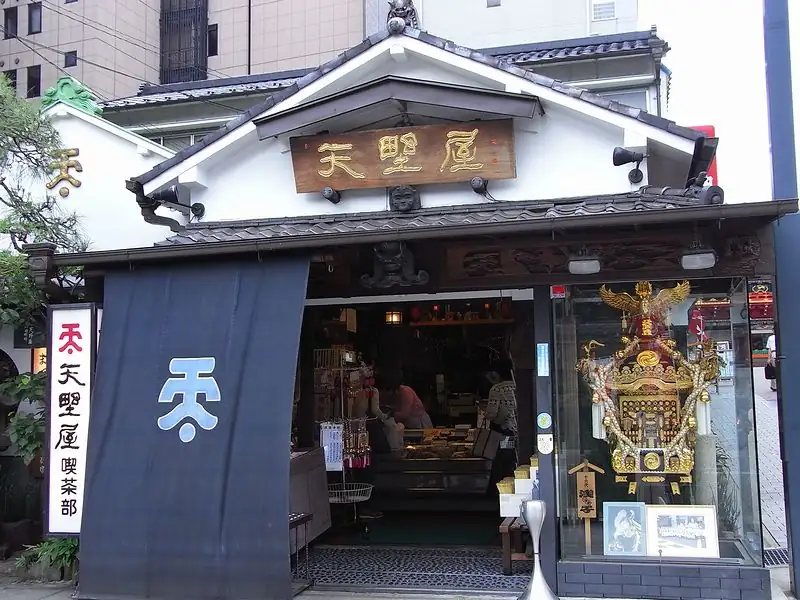
Amanoya, beside the great torii, was founded in 1846. Tradition says the founder came from the Miyazu domain in Tango Province and traveled to Edo to find the man who had killed his younger brother. Hoping to meet him among the worshippers, he opened a shop at the shrine gate. He never found him, and amazake became the family trade.[2,3]
The amazake is made from rice and koji alone, with no added sugar. The koji is grown in an earthen cellar dug about 6 m below the shop. Its brick lining dates from a rebuild in 1904, and in 2009 the cellar was designated a tangible cultural property of Chiyoda City. Each batch takes about a week.[2,3,4]
The shop burned in the air raids of March 1945 and was rebuilt after the war. The tea room next to the counter is decorated with old clocks and model trains, and serves amazake hot or chilled, shiratama (rice-flour dumplings) with sweet azuki beans, anmitsu and oshiruko (sweet red bean soup), with shaved ice topped with amazake in summer. The counter also sells foods made with koji, such as Shibasaki natto, Edo miso and Hisakata miso.[2,3,4,5]
Down the Otokozaka steps: Myojinshita Kandagawa
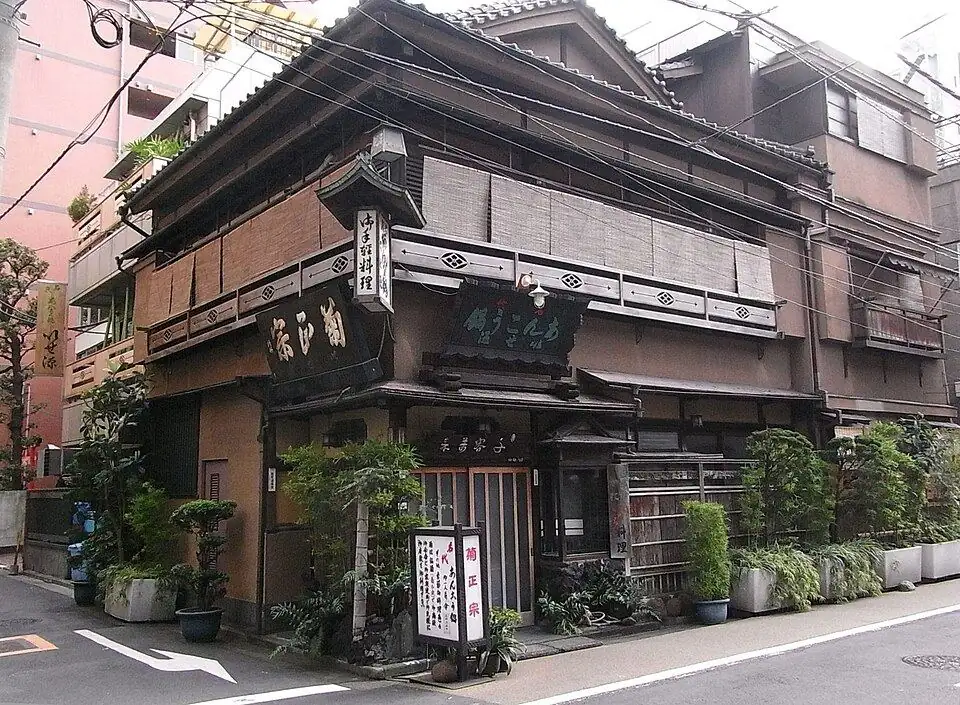
At the foot of the Otokozaka steps below Kanda Myojin, near the Myojinshita intersection, is Myojinshita Kandagawa, an eel restaurant founded in 1805. It is a wooden building from 1952 behind a black wooden fence. Across the road is the Akihabara electronics district.[9,10,11]
The eel is split along the back, skewered through the middle of the flesh and spread into a fan shape. It is grilled plain, steamed for 15 to 20 minutes to remove extra fat, then grilled with the sauce. The sauce is equal parts soy sauce and mirin, with no sugar. Both kabayaki (eel grilled with sauce) and shirayaki (eel grilled plain) are served on their skewers. The owner explains that skewering for an even finish is hard, and serving them this way shows the craftsman’s skill. The unaju (eel over rice in a lacquered box) comes with ground sansho pepper and Nara-zuke pickles.[9,10]
The eel is prepared after you order, so it takes about 40 minutes to arrive. Dinner requires a reservation. It is about a 6-minute walk from Ochanomizu Station (JR).[9,12]
The shrine’s sacred sake: Toshimaya Honten
One of the sakes offered at Kanda Myojin is Kinkon, made by Toshimaya Honten. Toshimaya traces its start to 1596, when its founder, Juemon, opened a shop that both sold and served sake at the Kamakura-gashi quay in Kanda. It began brewing its own sake in the mid-Meiji era (1868–1912) and moved its brewery to Higashimurayama, in western Tokyo, in the early Showa era. After the 1923 earthquake and the wartime air raids, the shop moved to Kanda-Sarugakucho after the war.[13,14]
The founder’s shirozake, a sweet, cloudy rice sake sold before the Doll Festival in March, became the talk of Edo; people said, “For mountains, Fuji; for shirozake, Toshimaya.” Today’s shirozake is still made the Edo-period way from glutinous rice, koji and mirin, with no added sugar, and is sold in the season before the festival. A shop beside the head office in Sarugakucho sells the company’s own sake. In 2020 it also opened Toshimaya Saketen, a sake shop with a standing bar, in Kanda-Nishikicho near where it began. The Sarugakucho shop is a 7-minute walk from the Ochanomizubashi Exit of JR Ochanomizu Station.[13,15,16,17]
Before you go
Mikawaya Ayabe Shoten and Amanoya are each about a 5- to 7-minute walk from Ochanomizu Station. Myojinshita Kandagawa is at the bottom of the shrine’s Otokozaka steps. Check each shop’s own information for opening days and hours before you go.[2,6,10]
When these shops were founded
Where they are
Numbered from the oldest. Positions are approximate.
Shops in this story
- Est. 1616Mikawaya Ayabe ShotenEnju amazakeSee this shop →
- Est. 1846AmanoyaMyojin amazakeSee this shop →
 Est. 1805Myojinshita Kandagawa (main shop)Kabayaki and shirayaki eelSee this shop →
 Est. 1596Toshimaya HontenShirozake and Kinkon sakeSee this shop →
Walks with these shops
Read next
Sources
- 神田明神 公式「神田明神とは」
- 旅go(たびまが)「天野屋」
- 東都のれん会「天野屋」
- さんたつ「天野屋」
- ことりっぷ「甘酒と甘酒スイーツが美味しい全国のお店6選」
- 千代田区観光協会「三河屋 綾部商店」
- 東京都味噌工業協同組合「有限会社三河屋綾部商店」
- さんたつ「徳川家康が江戸に遺した足跡を訪ねる」(2026年8月23日更新)
- 東都のれん会「明神下 神田川」
- 和樂web「東京のうなぎの名店4選」(2019年9月)
- 日刊ゲンダイ「明神下 神田川本店(外神田)」
- まっぷる「明神下 神田川本店」(2026年7月22日更新)
- 千代田区観光協会「豊島屋本店」
- 豊島屋本店 公式サイト「豊島屋本店について」
- 東都のれん会「豊島屋本店」
- 豊島屋本店 Yahoo!ショッピング店「白酒」(店の商品説明)
- 千代田区観光協会「豊島屋酒店」