Story · 2026-11-28 · About 6 min read
A thousand years at the gate: aburi-mochi and a tea house in Kyoto
An aburi-mochi teahouse on the approach to Imamiya Shrine is said to date from 1000, and a tea house at the foot of Uji Bridge from 1160. This story follows five shops at the gates of Murasakino and Uji in Kyoto, with sources.
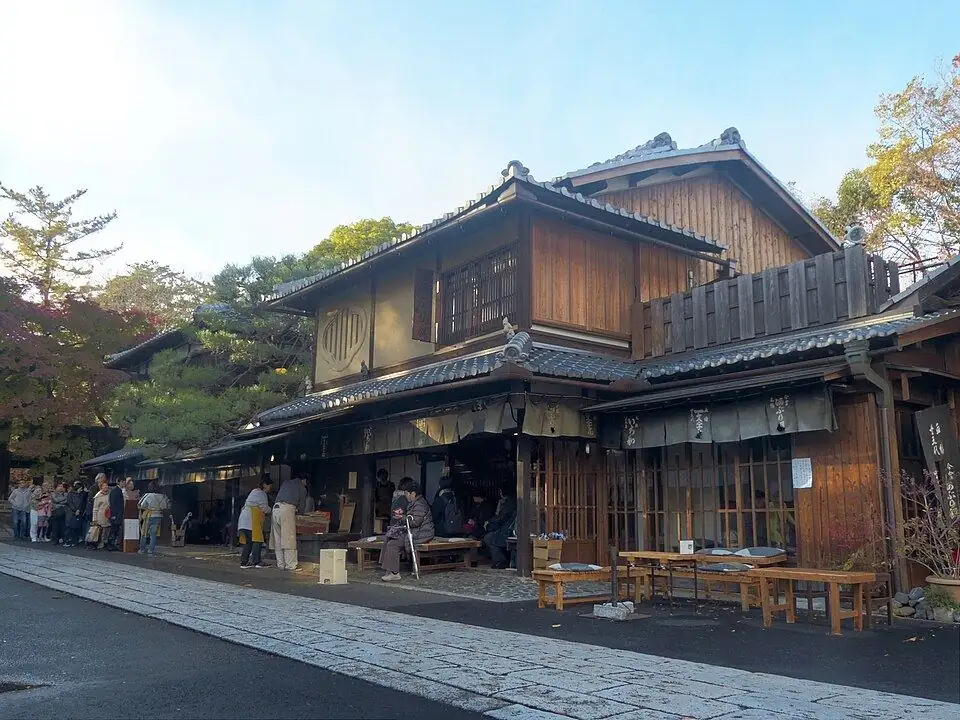
At shrine gates and a bridge
In Murasakino, in northern Kyoto, Imamiya Shrine stands near Daitokuji Temple. To the south, in Uji, Uji Bridge leads to Byodoin Temple. Both places still have sweet and tea shops with long histories. By family tradition, an aburi-mochi teahouse on the Imamiya approach dates from 1000, and a tea house at the foot of Uji Bridge from 1160.[2,9]
This story visits five listed shops in Murasakino and Uji and follows their histories as far as sources allow.[2,6,9,12,15]
Murasakino: aburi-mochi at Imamiya Shrine
Imamiya Shrine traces its origin to a ritual held in 994 to calm an epidemic in the capital. Rice cakes offered to the gods were grilled and eaten in hopes of good health. This is said to be how eating aburi-mochi (grilled rice cakes) after a visit became a custom, and the sweets came to be seen as a charm against misfortune.[1]
Ichimonjiya Wasuke (Ichiwa) stands on the approach outside the east gate. It is said to date from 1000, in the Heian period (794–1185), and to have been run by 25 generations since. The shop holds no records from its founding. Stories that it fed people fleeing the Onin War, and that the tea master Sen no Rikyu served its mochi with tea, have been passed down by word of mouth.[2,3,4]
Small rice cakes are dusted with kinako (roasted soybean flour), grilled over charcoal at the shopfront for each order, and served with a sweet white-miso sauce. Aburi-mochi is the only item. One serving is 11 skewers, and takeout starts from three servings. Parts of the building are said to be about 400 years old, and Kyoto City has certified it as one of the city’s treasured buildings.[2,3,4]
Two shops face each other on the north and south sides of the approach outside the east gate, and both sell only aburi-mochi. Ichiwa is the one on the north side. Accounts of their founding dates vary, and this story does not decide which came first.[4,5]
Murasakino: Matsuya Tobei by Daitokuji Temple
South of Imamiya Shrine, in front of Daitokuji Temple, is the Kyoto confectioner Matsuya Tobei. It dates from the Edo period (1603–1868) and is said to have been founded about 250 years ago, though accounts of the exact year vary.[6,7]
The signature Murasakino matsukaze is a baked cake made without eggs or butter. Its batter rises with white miso, and the shop’s own Daitokuji natto is baked into it. Shugyoku Orihime are tiny dry sweets of sugar and rice flour, flavored with sesame, plum, ginger, yuzu citrus and cinnamon.[6,8]
Sweets are laid out in a small shopfront, and people who practice the tea ceremony come here for them. Wooden molds for dry sweets, used from the late Edo period into the Meiji era (1868–1912), are on display. The shop is in Murasakino Unrinin-cho, Kita-ku.[6,8]
Uji: Tsuen at the east end of Uji Bridge
Tsuen, at the east end of Uji Bridge, is a tea house said to date from 1160. Tradition says its founder, a retainer of the warrior Minamoto no Yorimasa, built a hermitage at the foot of the bridge late in life and began serving tea. In 1180 he is said to have died with Yorimasa at Byodoin Temple after the Battle of the Uji River.[9,11]
The descendants took the Tsuen name, served as keepers of the bridge and offered tea to travelers. The seventh head is said to have been a friend of the monk Ikkyu. Under Toyotomi Hideyoshi the family was given the task of drawing river water for tea gatherings, and in 1596 it is said to have drawn water for a gathering at Fushimi Castle. The well bucket used then, made by Sen no Rikyu, is kept as a family treasure.[9,11]
The present building is said to date from 1672, and the shop says Tsuen appears in Miyako Meisho Zue, a guide to the capital published in 1780. The shop sells everything from everyday tea to fine and organic teas, and its tea room serves matcha sweets, soba made with matcha and sets of tea dango (rice dumplings on a skewer). It stands right in front of Uji Station on the Keihan Line, about a 7-minute walk east of JR Uji Station.[9,10]
Uji: Notonojo Inafusa Yasukane on the Byodoin approach
Midway along the approach to Byodoin Temple is Notonojo Inafusa Yasukane, a sweet shop founded in 1717. It was allowed to serve Omuro Gosho, today’s Ninnaji Temple in Kyoto, and in 1853 Ninnaji granted it the title Notonojo. Such titles were rarely given to merchants, and the shop puts it before its original name.[12,13,14]
The tea dango sold at the shopfront has been made since the Taisho era (1912–1926). Rice flour is kneaded with boiling water and steamed once, then matcha and sugar are added and it is steamed again for 40 to 50 minutes. The shop also makes Kisenyama, a thick senbei named after a mountain upstream of Uji Bridge linked to the poet Kisen Hoshi.[12,13]
In a 2017 interview three generations of the family worked in the shop, and a 2025 profile says the ninth head handles everything from making to selling. It is about an 8-minute walk from Keihan Uji Station, or about 10 minutes from JR Uji Station.[12,13,14]
Uji: Ochaman and tea dango
On the Ujibashi-dori shopping street, which runs from the west end of Uji Bridge toward JR Uji Station, is Sohonke Ochaman, founded in 1919. According to the shop, its founder, Suchi Mankichi, spent three years developing dumplings made with Uji tea, and the shop calls itself the originator of tea dango. Other shops in Uji, such as Inafusa Yasukane, have also made tea dango since the Taisho era, and this story does not decide which came first.[13,15,16,17]
The dough is made only from rice flour, kneaded with hot water and steamed, then sugar and matcha are worked in by hand. The craftsmen set the flour blend, water and steaming time by the day’s temperature and weather. There are matcha and hojicha (roasted green tea) versions. Because no preservatives are used, they are said to keep their proper flavor for only about two days after making. The attached café serves the dango. It is about a 5-minute walk from JR Uji Station.[15,16,17]
Before you go
Ichiwa posts its open days on Facebook, and Tsuen announces closing days on its official website. Check each shop’s own information for opening days and hours before you go.[3,10]
When these shops were founded
Where they are
Numbered from the oldest. Positions are approximate.
Shops in this story
- Est. c. 1000Ichimonjiya Wasuke (Ichiwa)Aburi-mochi (grilled rice cakes)See this shop →
- Est. c. 1776Matsuya TobeiMurasakino matsukaze (miso sponge cake)See this shop →
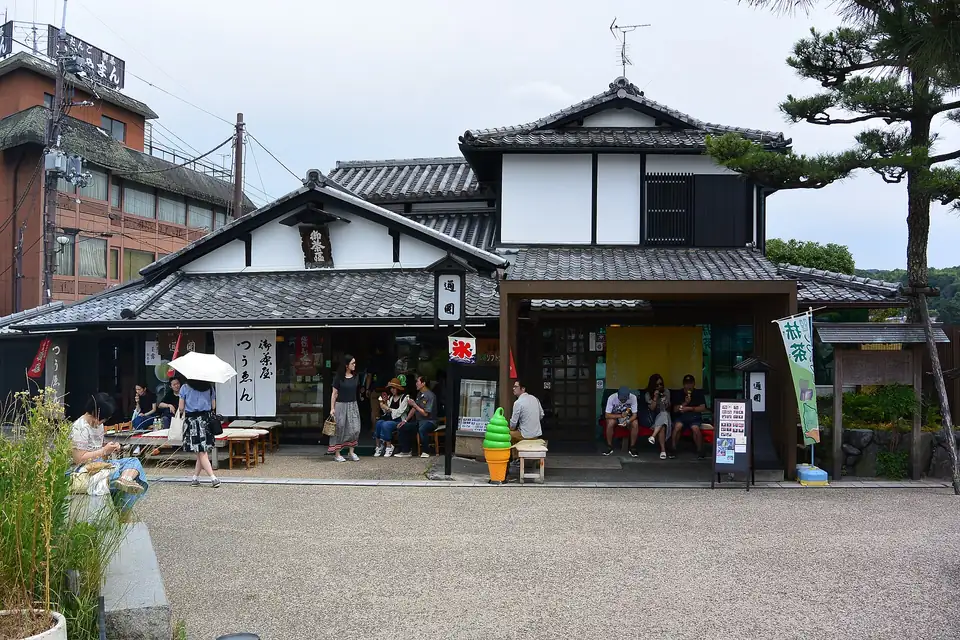 Est. c. 1160TsuenMatcha with sweetsSee this shop →
 Est. 1717Notonojo Inafusa YasukaneTea dangoSee this shop →
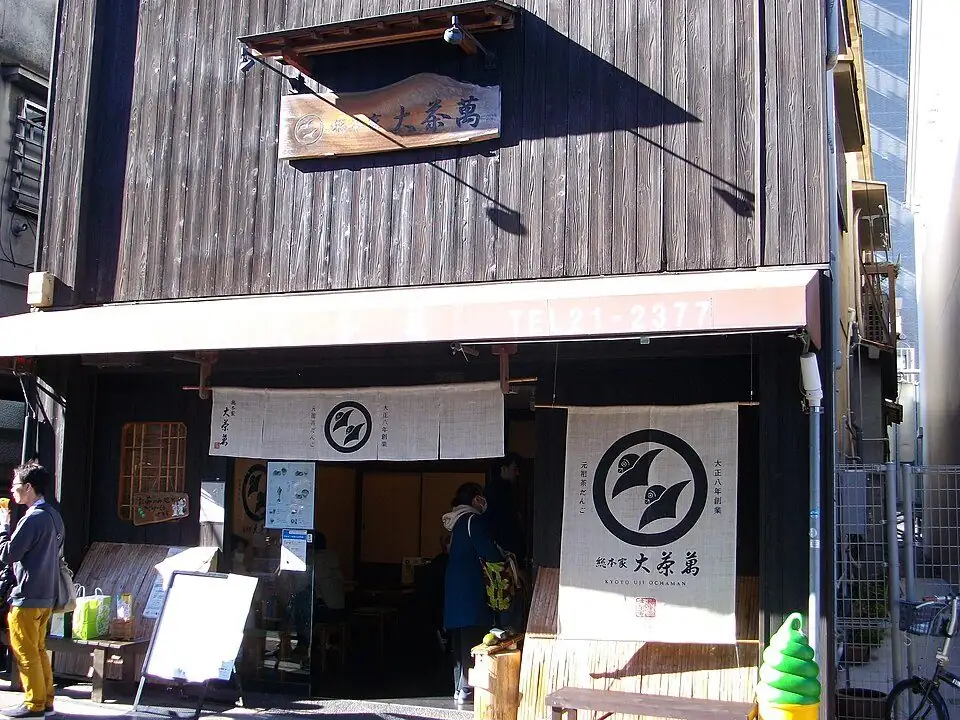 Est. 1919Sohonke OchamanTea dango (matcha and hojicha)See this shop →
Walks with these shops
- Kyoto: north from Demachi4 shopsFrom Demachi’s mame-mochi and ajari-mochi to Nishijin sweets and Imamiya Shrine’s aburi-mochi.See the route
- Uji: by Byodoin4 shopsFrom the teahouse at Uji Bridge to the Byodoin approach: Uji tea and tea dango.See the route
Read next
Related origins
Sources
- そうだ 京都、行こう。(JR東海)「出来たてを召し上がれ! 今宮神社のあぶり餅」
- 京都市「京都を彩る建物や庭園」選定・認定リスト(令和7年3月)
- 和樂web「古社の伝統菓子【京都の「門前」にうまいものあり!】」(2024年4月)
- 日経ビジネス電子版「1000年受け継いできた味 一文字屋和輔」
- 京都府観光連盟「あぶり餅」
- ことりっぷ「京都よりみちこみち 大徳寺通&今宮通【後編】」
- あまから手帖 Online「茶の湯とともに受け継ぐ京都・紫野『松屋藤兵衛』の菓子づくり」(2026年8月)
- 京都府菓子工業組合「松屋藤兵衛」
- 通圓 公式サイト「通圓の歴史」
- 通圓 公式サイト「店舗の紹介」
- JR西日本「Blue Signal」vol.172
- 京阪電車「おけいはん」京の名店 No.108(2017年4月取材)
- GO KYOTO「能登椽 稲房安兼」(2025年8月)
- るるぶ&more.「能登椽 稲房安兼」
- 旅go(たびまが)「総本家大茶萬」
- 京都宇治土産.com(宇治商工会議所)「総本家 大茶萬」
- 総本家 大茶萬 公式オンラインショップ